Awwwards (Awwwards Online SL) is an organization that hosts web design competitions and conferences across Europe and the United States. Website owners and developers can participate by submitting their websites for review. Submissions are assessed by a jury, and top entries are presented and awarded prizes on a rotational basis. == Nomination process == Web designers submit their websites through Awwwards' platform for consideration for the Site of the Day. A jury, composed of industry professionals, and the Awwwards community evaluate the entries. The best daily sites are published annually in "The 365 Best Websites Around the World" book. == Jury == The jury consists of international designers, developers, and agencies who assess the creativity, technical skills, and insight of the submitted web projects. The panel's expertise ensures a comprehensive review process. === Developer Award === Awwwards, in partnership with Microsoft, created the Developer Award to recognize web developers who demonstrate excellence in creating websites that meet modern standards. The award highlights websites that work seamlessly across various platforms and devices, using best practices in HTML5, JavaScript, and CSS. == Annual winners == Some prominent Site of the Year winners include Mercedes-Benz, Bloomberg L.P., Bose Corporation, Warner Brothers, Volkswagen, Uber, and Google. == Awwwards conference == Awwwards also organizes two-day conferences featuring speakers from major tech companies and industry leaders such as Microsoft, Google, Spotify, Adobe, Opera, and Smashing Magazine. These events focus on the latest trends in web design and development. Speakers at Awwwards conferences have included notable figures in the design and technology industry such as Stefan Sagmeister, Paula Scher, and design leaders from companies including Wix. == Corporate affairs == === Platform === Awwwards operates an online platform where web designers and developers submit websites for evaluation and awards. Submitted projects are reviewed by a jury based on design, usability, creativity, and content. The platform also serves as a community hub for discovering digital trends, showcasing work, and accessing educational resources including talks and interviews. Design professionals from international companies have participated in Awwwards events and platform content. For example, Wix, a cloud-based web development company known for its website builder tools, has featured prominently in Awwwards conferences, with its design leadership contributing to discussions on design trends and creative thinking.
Acoustic model
An acoustic model is used in automatic speech recognition to represent the relationship between an audio signal and the phonemes or other linguistic units that make up speech. The model is learned from a set of audio recordings and their corresponding transcripts. It is created by taking audio recordings of speech, and their text transcriptions, and using software to create statistical representations of the sounds that make up each word. == Background == Modern speech recognition systems use both an acoustic model and a language model to represent the statistical properties of speech. The acoustic model models the relationship between the audio signal and the phonetic units in the language. The language model is responsible for modeling the word sequences in the language. These two models are combined to get the top-ranked word sequences corresponding to a given audio segment. Most modern speech recognition systems operate on the audio in small chunks known as frames with an approximate duration of 10ms per frame. The raw audio signal from each frame can be transformed by applying the mel-frequency cepstrum. The coefficients from this transformation are commonly known as mel-frequency cepstral coefficients (MFCCs) and are used as an input to the acoustic model along with other features. Recently, the use of convolutional neural networks has led to major improvements in acoustic modeling. == Speech audio characteristics == Audio can be encoded at different sampling rates (i.e. samples per second – the most common being: 8, 16, 32, 44.1, 48, and 96 kHz), and different bits per sample (the most common being: 8-bits, 16-bits, 24-bits or 32-bits). Speech recognition engines work best if the acoustic model they use was trained with speech audio which was recorded at the same sampling rate/bits per sample as the speech being recognized. == Telephony-based speech recognition == The limiting factor for telephony based speech recognition is the bandwidth at which speech can be transmitted. For example, a standard land-line telephone only has a bandwidth of 64 kbit/s at a sampling rate of 8 kHz and 8-bits per sample (8000 samples per second 8-bits per sample = 64000 bit/s). Therefore, for telephony based speech recognition, acoustic models should be trained with 8 kHz/8-bit speech audio files. In the case of voice over IP, the codec determines the sampling rate/bits per sample of speech transmission. Codecs with a higher sampling rate/bits per sample for speech transmission (which improve the sound quality) necessitate acoustic models trained with audio data that matches that sampling rate/bits per sample. == Desktop-based speech recognition == For speech recognition on a standard desktop PC, the limiting factor is the sound card. Most sound cards today can record at sampling rates of between 16–48 kHz of audio, with bit rates of 8- to 16-bits per sample, and playback at up to 96 kHz. As a general rule, a speech recognition engine works better with acoustic models trained with speech audio data recorded at higher sampling rates/bits per sample. But using audio with too high a sampling rate/bits per sample can slow the recognition engine down. A compromise is needed. Thus for desktop speech recognition, the current standard is acoustic models trained with speech audio data recorded at sampling rates of 16 kHz/16 bits per sample.
Visual Peer Review
== Development and history == Visual Peer Review was first described in a 2017 classroom study by Friedman and Rosen, which examined how students evaluate peer-produced data visualizations using structured rubrics. Developed within the broader fields of data visualization, information visualization, and educational technology, the system emphasized clear labeling, visual integrity, and reduction of chartjunk. Students assigned rubric scores and provided written explanations, aligning the activity with established principles of peer review. Follow-up research expanded both the methodological and analytic dimensions of the framework. Friedman and colleagues applied natural language processing (NLP) to peer-review text to analyze part-of-speech patterns, sentence complexity, and comment length. These analyses offered insight into how students expressed critique and engaged with core design principles. Later studies incorporated advanced statistical modeling to evaluate system-level behavior, including peer review networks and reviewer typologies. Between 2021 and 2024, the framework underwent iterative refinement through a series of studies that explored interface design, behavioral nudges, reviewer engagement, and social network dynamics. The system was influenced by earlier work in computer-supported peer review—particularly My Reviewers, a rubric-based writing assessment platform developed by Joe Moxley at the University of South Florida. While Moxley's platform focused on text-based feedback, Visual Peer Review adapted its core structure to support critique of DataVis and visual analytics. To guide structured analysis and feedback, Friedman and Rosen also drew on the “what, why, and how” framework introduced by Liu and Stasko (2010), which emphasizes understanding a visualization's purpose, task alignment, and encoding strategy. == Framework and components == Visual Peer Review is designed to support critique, reflection, and learning in courses focusing on data visualization, visual analytics, and related fields in educational technology. The system consists of interconnected component. Core components include: Visual Artifacts: Students generate original visualizations using software such as R (e.g., ggplot2), Tableau, Python, or Adobe Illustrator. These artifacts may include statistical graphics, dashboards, or design-oriented infographics. Rubric-Based Assessment: Peer reviewers evaluate submitted visualizations using structured rubrics grounded in visualization theory and design heuristics. Rubric dimensions typically include: Use of labeling and axis scales Minimalization of chartjunk and clutter (following Tufte's principles) Optimization of the data–ink ratio Preservation of visual integrity through accurate representation (lie factor) Written Peer Comments: In addition to scoring, reviewers provide narrative feedback explaining their reasoning. These comments aim to improve design literacy, strengthen visual reasoning, and support the learning process common to peer review across educational contexts. Instructor Analytics Dashboard: Instructors access an analytics dashboard that displays peer-review activity across the course. Metrics include comment length, rubric coverage, participation patterns, and potential indicators of disengagement. These features position the framework within the domain of learning analytics, where visualized data helps instructors monitor student progress and identify support needs. == Ongoing development == Current work focuses on enhancing rubric structure, integrating principles from human–computer interaction, DataVis and expanding learning-analytics capabilities. Ongoing studies investigate how interface design, reviewer behavior, and classroom context influence the quality of feedback and overall engagement. Continuing development positions Visual Peer Review at the intersection of data visualization education, peer assessment, and educational technology.
Run-to-completion scheduling
Run-to-completion scheduling or nonpreemptive scheduling is a scheduling model in which each task runs until it either finishes, or explicitly yields control back to the scheduler. Run-to-completion systems typically have an event queue which is serviced either in strict order of admission by an event loop, or by an admission scheduler which is capable of scheduling events out of order, based on other constraints such as deadlines. Some preemptive multitasking scheduling systems behave as run-to-completion schedulers in regard to scheduling tasks at one particular process priority level, at the same time as those processes still preempt other lower priority tasks and are themselves preempted by higher priority tasks.
AI: When a Robot Writes a Play
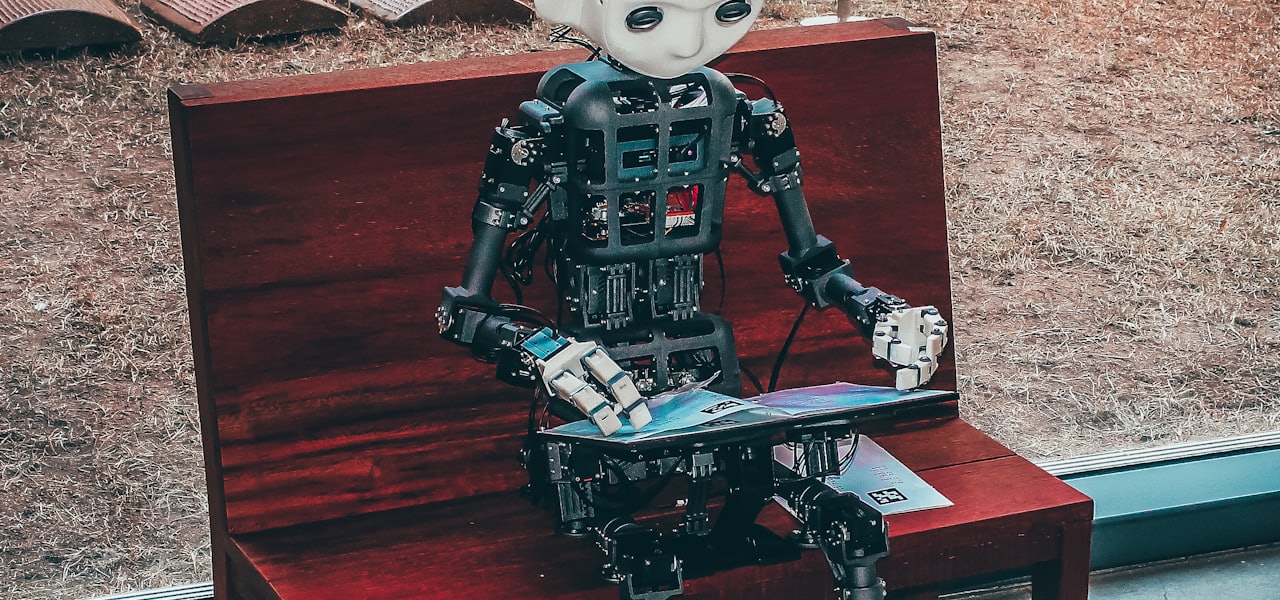
AI: When a Robot Writes a Play (in Czech: AI: Když robot píše hru) is a 2021 experimental theatre play, where 90% of its script was automatically generated by artificial intelligence (the GPT-2 language model). The play is in Czech language, but an English version of the script also exists. == Creation == The play is the first result of the THEaiTRE research project, aiming to commemorate the centenary of the R.U.R. play by Karel Čapek by investigating to what extent artificial intelligence could be used to create theatre play scripts. The script of the play was created using the THEaiTRobot tool, based on the GPT-2 language model. First, the play dramaturge, David Košťák, described the initial setting of each scene in a few sentences, and wrote the first line for each character. Next, THEaiTRobot suggested a continuation of the script, which the dramaturge could use, reject, or use part of it and let the tool generate a new continuation. Another option was to manually insert another line or a scenic remark. The script was generated in English and was automatically translated to Czech by the state-of-the-art CUBBITT machine translation tool. The resulting script was then further post-edited by the dramaturge. The resulting script was made freely available for non-commercial use both in English and in Czech, with marked manually inserted texts and manual edits. The analysis shows that 90% of the English script is automatically generated, with 10% manually written or manually post-edited. In the Czech script, a larger amount of edits were made, but the analysis claims that these additional edits are corrections of errors of the automated translation and stylistic corrections which do not change the meaning of the lines as represented by the English script, but rather bring the Czech script closer to the English one. == Characters == The play contains 9 characters. The Robot appears in all the scenes, while each of the other characters appears in only one scene. Robot – The lead character, a male humanoid robot. Master – An old man, the creator of the Robot. Boy – A schoolboy. Masseuse – A sex worker in a brothel. Stranger – An engineer. Man. Psychologist. Administrator – A female clerk at an employment agency. Actress – A film actress and a model in a robot-like costume. == Plot == The play is composed of 8 scenes. It tells the story of a humanoid robot, who encounters 8 other characters and engages into various typically human situations and activities, related to death, love, sex, violence, etc. The individual scenes are not tightly linked, but there are some linking points, such as the central character of the robot or some repeated and developing themes, such as the robot's search for love. The scenes often contain some absurd turns and it is often hard to find sense in them. It is therefore a very complicated piece interpretationally, requiring the director and the actors to invest a lot of effort and creativity in finding a meaningful interpretation which would not deviate from the script. In the interpretation by Švanda theatre, who premiered the play and who also participated on the creation of the script, the scenes typically contain non-verbally expressed content which can add a lot to the meaning of the scene compared to what is contained in the actual script (as the script only contains the lines said by the characters). === Scene 1: Death === The play opens by the Robot parting with his dying Master. The Master gives the Robot several last lessons and talks with him about death, soul, and love. === Scene 2: Sense of Humour === In the second scene, the Robot meets a sad and angry Boy, who complains that he wants to go to school, that his girlfriend is crazy, that he wants to buy a car, etc. The Robot tries to help the Boy by giving him advice, but the Boy's reactions are quite negative and irritated. The Boy then repeatedly asks the Robot to tell him a joke; the Robot keeps refusing, but ultimately tells the following joke: When you are dead. When your children are dead. When your grandchildren are dead, I will be still alive. === Scene 3: Nightclub === The Robot wants to feel pleasure, so he goes to a "night club" (a brothel), where he meets a "Masseuse" (a prostitute). The Robot is initially "a bit cold", but eventually manages to enjoy the experience and falls in love with the Masseuse. In the Švanda theatre performance, the Robot and the Masseuse seem to have a sort of virtual sex without touching each other, reminiscent of the sex scene in Demolition Man. === Scene 4: Fear of the Dark === It is the night. The Robot is standing under a lamp, unable to move away from the light as he finds that he is afraid of the dark. He meets a Stranger, an engineer who tells him that robots don't have feelings and that people cannot be trusted, and keeps hurting him. In the Švanda theatre performance, the Man repeatedly zaps the Robot with some kind of electric pulse. === Scene 5: Killer Robot === A Man approaches the Robot and repeatedly asks him to kill him. Instead, the Robot sticks a finger into the Man's anus, which leads to an argument between the Man and the Robot. === Scene 6: Burn Out === The Robot meets a Psychologist, who keeps asking him lots of questions regarding his life, burnout feeling, love, relationships, and emotions. They also talk about the Robot using a device called emotion machine which helps him to get rid of stress. === Scene 7: Search for Job === The Robot comes to an employment agency. He meets an Administrator and asks her to help him find a job. He expresses the wish to become an actor, and talks about his experience as a clown. He reveals his name to be Troy McClure, which is a character from The Simpsons who is an actor. In the Švanda theatre performance, the Administrator starts to seduce the Robot once his name is revealed, which he keeps ignoring; the Administrator then becomes irritated. === Scene 8: Love at First Sight === The Robot meets a human Actress in a robotic costume and falls in love with her immediately. The Actress is first reluctant, but the Robot manages to seduce her and she also falls in love with him. The Robot tells her about a binary world, in which he lives and where he will also take her. Ultimately, the Actress agrees, and the whole play concludes by the Robot and the Actress promising each to other to always be together. In the Švanda theatre performance, the Robot does not have a physical body in this scene, we can only hear his voice and see a pulsating light (based on the line in the script where the Robot says: "I have no body. So I don't need to wear clothes. You can't see me, you only hear me."), and the Actress eventually also agrees to lose her physical body so that she can be with the Robot forever. == Theatrical performances == The play premiered on 26 February 2021 in Švanda Theatre in Prague, Czech Republic, directed by Daniel Hrbek. Due to the COVID-19 pandemic, the play was not played in front of a live audience, but it was broadcast online, in Czech language with English subtitles. The play was followed by a panel discussion by the project members and experts on artificial intelligence. The premiere was viewed by 13,498 spectators worldwide. A short trailer of the premiere is available on YouTube. In 2021, after the opening of the theatres in the Czech Republic to spectators, the play can be viewed at Švanda Theatre. The performance takes approximately 60 minutes, and is followed by a discussion of the creators with the audience. The derniere is planned for 4 February 2023. == Reception == The play received a number of reviews, both in its country of origin as well as internationally. It is praised as first of its kind, although some reviewers note the similarity to previous works, such as the musical Beyond the Fence, the play Lifestyle of the Richard and Family, or the short movie Sunspring; however, these works used less advanced technology, and either were very short (Sunspring) or necessitated a larger amount of human interventions. The reviewers note that the script is far from perfect, with many inconsistencies and nonsensical parts, and conclude that the technology is definitely not yet ready to replace human authors; however, some find some parts of the script frighteningly human-like. The amount of human intervention is a somewhat controversial topic, with some reviewers finding the human influence too large (especially in interpreting the script and putting the play on scene), while others feel that a greater amount of human intervention would have been favorable as this could greatly improve the quality of the play. The reviews also frequently comment on the amount of sex, violence and strong language in the play; this can be attributed to the method used for creating the script, where the GPT-2 language model reflects topics and language common in the human-written articles on the internet that were used to train the model. Furthermore, some r
Cloud management
Cloud management refers to the administration and oversight of cloud computing products and services. Public clouds are managed by cloud service providers, which operate the underlying infrastructure such as servers, storage, networking, and data center facilities. Users may also opt to manage their public cloud services with a third-party cloud management tool. Users of public cloud services can generally select from three basic cloud provisioning categories: User self-provisioning: Customers purchase cloud services directly from the provider, typically through a web form or console interface. The customer pays on a per-transaction basis. Advanced provisioning: Customers contract in advance a predetermined amount of resources, which are prepared in advance of service. The customer pays a flat fee or a monthly fee. Dynamic provisioning: The provider allocates resources when the customer needs them, then decommissions them when they are no longer needed. The customer is charged on a pay-per-use basis. Managing a private cloud requires software tools to help create a virtualized pool of compute resources, provide a self-service portal for end users and handle security, resource allocation, tracking and billing. Management tools for private clouds tend to be service driven, as opposed to resource driven, because cloud environments are typically highly virtualized and organized in terms of portable workloads. In hybrid cloud environments, compute, network and storage resources must be managed across multiple domains, so a good management strategy should start by defining what needs to be managed, and where and how to do it. Policies to help govern these domains should include configuration and installation of images, access control, and budgeting and reporting. Access control often includes the use of Single sign-on (SSO), in which a user logs in once and gains access to all systems without being prompted to log in again at each of them. == Characteristics of Cloud Management == Cloud management combines software and technologies in a design for managing cloud environments. Software developers have responded to the management challenges of cloud computing with a variety of cloud management platforms and tools. These tools include native tools offered by public cloud providers as well as third-party tools designed to provide consistent functionality across multiple cloud providers. Administrators must balance the competing requirements of efficient consistency across different cloud platforms with access to different native functionality within individual cloud platforms. The growing acceptance of public cloud and increased multicloud usage is driving the need for consistent cross-platform management. Rapid adoption of cloud services is introducing a new set of management challenges for those technical professionals responsible for managing IT systems and services. Cloud-management platforms and tools should have the ability to provide minimum functionality in the following categories. Functionality can be both natively provided or orchestrated via third-party integration. Provisioning and orchestration: create, modify, and delete resources as well as orchestrate workflows and management of workloads Automation: Enable cloud consumption and deployment of app services via infrastructure-as-code and other DevOps concepts Security and compliance: manage role-based access of cloud services and enforce security configurations Service request: collect and fulfill requests from users to access and deploy cloud resources. Monitoring and logging: collect performance and availability metrics as well as automate incident management and log aggregation Inventory and classification: discover and maintain pre-existing brownfield cloud resources plus monitor and manage changes Cost management and optimization: track and rightsize cloud spend and align capacity and performance to actual demand Migration, backup, and DR: enable data protection, disaster recovery, and data mobility via snapshots and/or data replication Organizations may group these criteria into key use cases including Cloud Brokerage, DevOps Automation, Governance, and Day-2 Life Cycle Operations. Enterprises with large-scale cloud implementations may require more robust cloud management tools which include specific characteristics, such as the ability to manage multiple platforms from a single point of reference, or intelligent analytics to automate processes like application lifecycle management. High-end cloud management tools should also have the ability to handle system failures automatically with capabilities such as self-monitoring, an explicit notification mechanism, and include failover and self-healing capabilities. == Multi-Cloud and Hybrid Cloud Management Challenges == Legacy management infrastructures, which are based on the concept of dedicated system relationships and architecture constructs, are not well suited to cloud environments where instances are continually launched and decommissioned. Instead, the dynamic nature of cloud computing requires monitoring and management tools that are adaptable, extensible and customizable. Cloud computing presents a number of management challenges. Companies using public clouds do not have ownership of the equipment hosting the cloud environment, and because the environment is not contained within their own networks, public cloud customers do not have full visibility or control. Users of public cloud services must also integrate with an architecture defined by the cloud provider, using its specific parameters for working with cloud components. Integration includes tying into the cloud APIs for configuring IP addresses, subnets, firewalls and data service functions for storage. Because control of these functions is based on the cloud provider’s infrastructure and services, public cloud users must integrate with the cloud infrastructure management. Capacity management is a challenge for both public and private cloud environments because end users have the ability to deploy applications using self-service portals. Applications of all sizes may appear in the environment, consume an unpredictable amount of resources, then disappear at any time. A possible solution is profiling the applications impact on computational resources. As result, the performance models allow the prediction of how resource utilization changes according to application patterns. Thus, resources can be dynamically scaled to meet the expected demand. This is critical to cloud providers that need to provision resources quickly to meet a growing demand by their applications. Charge-back—or, pricing resource use on a granular basis—is a challenge for both public and private cloud environments. Charge-back is a challenge for public cloud service providers because they must price their services competitively while still creating profit. Users of public cloud services may find charge-back challenging because it is difficult for IT groups to assess actual resource costs on a granular basis due to overlapping resources within an organization that may be paid for by an individual business unit, such as electrical power. For private cloud operators, charge-back is fairly straightforward, but the challenge lies in guessing how to allocate resources as closely as possible to actual resource usage to achieve the greatest operational efficiency. Exceeding budgets can be a risk. Hybrid cloud environments, which combine public and private cloud services, sometimes with traditional infrastructure elements, present their own set of management challenges. These include security concerns if sensitive data lands on public cloud servers, budget concerns around overuse of storage or bandwidth and proliferation of mismanaged images. Managing the information flow in a hybrid cloud environment is also a significant challenge. On-premises clouds must share information with applications hosted off-premises by public cloud providers, and this information may change constantly. Hybrid cloud environments also typically include a complex mix of policies, permissions and limits that must be managed consistently across both public and private clouds. == Cloud Management Platforms (CMP) == CMPs provide a means for a cloud service customer to manage the deployment and operation of applications and associated datasets across multiple cloud service infrastructures, including both on-premises cloud infrastructure and public cloud service provider infrastructure. In other words, CMPs provide management capabilities for hybrid cloud and multi-cloud environments. A cloud management platform (CMP) provides broad cloud management functionality atop both public cloud provider platforms and private cloud platforms. CMPs manage cloud services and resources that are distributed across multiple cloud platforms. The value of CMPs stands in delivering the maximum level of consistency between platforms without comp
List of information schools
This list of information schools, sometimes abbreviated to iSchools, includes members of the iSchools organization. The iSchools organization reflects a consortium of over 130 information schools across the globe. == History == The first iSchools Caucus was formed in 1988 by Syracuse, Pittsburgh, and Drexel and was called the Gang of Three (sometimes gang of four with Rutgers). Syracuse renamed the School of Library Science as the School of Information Studies in 1974, and is considered as the first “iSchool” in history. The group was formally named "the iSchools Caucus" or more casually, the iCaucus. By 2003, the group expanded to include the Universities of Michigan, Washington, Illinois, UNC, Florida State, Indiana, and Texas, and was called the Gang of Ten. The current iSchools Caucus organization was formalized by 2005, with additions of UC Berkeley, UC Irvine, UCLA, Penn State, Georgia Tech, Maryland, Toronto, Carnegie Mellon and Singapore Management University. == iSchools organization == The iSchools promote an interdisciplinary approach to understanding the opportunities and challenges of information management, with a core commitment to concepts like universal access and user-centered organization of information. The field is concerned broadly with questions of design and preservation across information spaces, from digital and virtual spaces such as online communities, social networking, the World Wide Web, and databases to physical spaces such as libraries, museums, collections, and other repositories. "School of Information", "Department of Information Studies", or "Information Department" are often the names of the participating organizations. Degree programs at iSchools include course offerings in areas such as information architecture, design, policy, and economics; knowledge management, user experience design, and usability; preservation and conservation; librarianship and library administration; the sociology of information; and human-computer interaction and computer science. === Leadership === The executive committee of the iSchools is made up of the current chair (Ina Fourie, University of Pretoria, South Africa), past chair (Gillian Oliver, Monash University, Australia) and the chair elect (Javed Mostafa, University of Toronto Canada), plus representatives from the three regions (North America, Europe, and Asia-Pacific). The current executive director is Slava Sterzer. == Member institutions == Between 2010 and 2026, the organization expanded globally beyond North America, growing to 133 member schools as of March 2026. For an updated and complete list of member schools, please visit the member database of the iSchools. == iConferences == Members of the iSchools organize a regular academic conference, known as the iConference, hosted by a different member institution each year. September 2005: Pennsylvania State University October 2006: University of Michigan February 2008: University of California, Los Angeles February 2009: University of North Carolina February 2010: University of Illinois at Urbana-Champaign February 2011: University of Washington, Seattle February 2012: University of Toronto February 2013: University of North Texas March 2014: Humboldt-Universität zu Berlin March 2015: University of California, Irvine March 2016: Drexel University March 2017: Wuhan University March 2018: University of Sheffield and Northumbria University March 2019: University of Maryland March 2020: University of Borås (virtual only) March 2021: Renmin University of China (virtual only) February/March 2022: University of Texas at Austin, University College Dublin & Kyushu University (virtual only) March 2023: Universitat Oberta de Catalunya March 2024: Jilin University March 2025: Indiana University March/April 2026: Edinburgh Napier University 2027: Victoria University of Wellington == Other schools of information == Other information schools and programs include: Documentation Research and Training Centre, Indian Statistical Institute, Bangalore San Jose State University, School of Information University of Southern California Library Science Degree Ankara University, Department of Information and Records Management, Ankara/Turkey Marmara University, Department of Information and Records Management, Istanbul/Turkey University of Kelaniya, Department of Library and Information Science, Kelaniya/Sri Lanka University of Colombo, National Institute of Library and Information Science (NILIS), Colombo/Sri Lanka Chicago State University, Department of Information Studies